Do I Need an Air Quality Assessment for Planning?
If you're asking "do I need an air quality assessment for my planning application?", you're not alone. It's one of the most common questions architects and developers raise, partly because the answer isn't fixed in national law and partly because every local authority handles it slightly differently. The short version is that an air quality assessment is required when your development either creates a new air quality problem or places people in an existing one. This page sets out the common triggers, drawn from IAQM/EPUK guidance and typical council validation lists, so you can work out where your scheme stands.
If you want to check your site against the main risk areas, our AQMA screening tool and London AQFA checker are a sensible starting point.
The common triggers
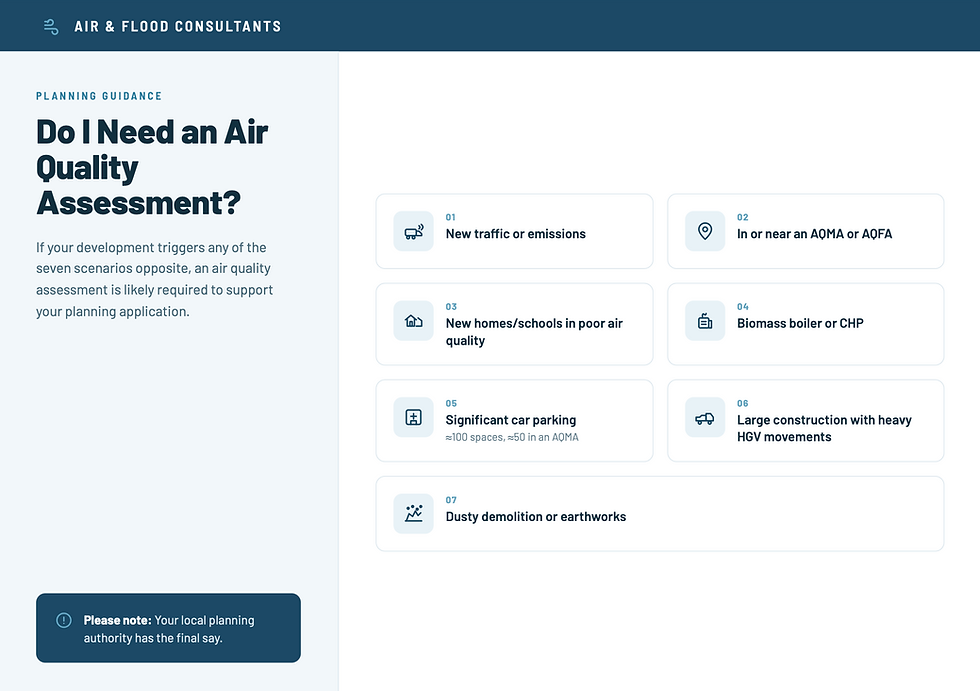
Most assessments are prompted by one or more of the following. If your scheme ticks any of these boxes, expect the question to come up.
New emissions or significant new traffic
If your development introduces new sources of pollution, or generates a meaningful increase in traffic on local roads, the local planning authority will usually want to understand the air quality effect. Traffic is the most common trigger for residential and mixed-use schemes, because more vehicle movements mean more emissions at the roadside, where people live.
.webp)
Sites in or near an AQMA or AQFA
Where a local authority has declared an Air Quality Management Area (AQMA), it has formally recognised that pollution exceeds national objectives there. Developing in or close to an AQMA almost always raises an air quality question. In London, the equivalent flag is an Air Quality Focus Area (AQFA), a location identified by the GLA as having high pollution and exceedances alongside human exposure. Both should put air quality firmly on your checklist.

Introducing new sensitive receptors into poor air quality
Even a development with modest traffic can trigger an assessment if it puts new sensitive receptors, such as homes, schools or care homes, into an area where air quality is already poor. The concern here is exposure: you're placing people where pollutant concentrations may be above the objectives, and the authority will want to see that addressed, often through layout, ventilation or mitigation.

Biomass boilers and biomass CHP
Combustion plant is a classic trigger. If your scheme includes a biomass boiler or biomass combined heat and power (CHP) unit, it introduces a new emission source with a flue, and that typically requires an air quality assessment regardless of the development's size.
.webp)
Significant new car parking
New parking concentrates vehicle movements and idling. A widely cited rule of thumb from IAQM/EPUK screening criteria is that around 100 or more parking spaces outside an AQMA, or around 50 or more within one, can be enough to warrant an assessment. These are screening indicators rather than hard limits, but they're a useful gauge.

Large or long construction projects
Construction itself generates emissions. Where a site involves heavy goods vehicle movements over a sustained period, often cited as more than around 200 HGV movements per day across a long programme, the construction-phase traffic can be enough to require assessment on its own.
.webp)
Dust-generating works
Demolition, earthworks and construction all produce dust, which can affect nearby properties and people. This is usually handled through a construction dust risk assessment, which evaluates the dust risk from each phase and sets out the control measures. Many councils expect one as standard for anything beyond minor works.
.webp)
The local authority always has the final say
Here's the important caveat. None of these triggers is an absolute rule. The decision on whether an air quality assessment is required, and what form it takes, rests with the local planning authority and its Environmental Health team. Validation lists vary from council to council, and a scheme that needs an assessment in one borough might not in another. The triggers above tell you when to expect the question, but your local validation requirements and any pre-application advice are the definitive guide. If in doubt, it's worth checking the council's local list or asking us to review it for you.

Basic or detailed: which assessment?
If you do need one, the next question is what depth of work is required.
A **basic, qualitative assessment**, sometimes called an air quality statement, is desk-based and suits minor developments and lower-risk sites. It reviews background data and the local picture and assesses the proposal against guidance, without bespoke modelling.
A **detailed assessment** uses dispersion modelling, typically ADMS, with local meteorological and traffic data, and is expected for major developments (broadly more than 10 dwellings or over 1,000 sqm of commercial floorspace) and for schemes with significant traffic or emission sources. It predicts pollutant concentrations at each receptor and is a more involved technical exercise. Our air quality assessment service covers both tiers, and we'll advise which one your application genuinely needs.

What happens if you skip it
Submitting without an assessment your council expects is a common cause of an application being held at validation or refused. Environmental Health may object, the case officer may issue a holding direction, and you lose time while you commission the report you could have provided at the outset. Getting the air quality question answered early keeps your application moving.

Get in Touch
Not sure whether your scheme needs an assessment? Send us your site address and a short description of the proposal and we'll tell you honestly whether one is likely to be required and which type.
Get in touch to discuss your site and receive a quote.
.webp)