Flood Risk Assessment for an Extension
Do I Need a Flood Risk Assessment for an Extension?
If you're planning to extend your home, you might be wondering whether you need a flood risk assessment for an extension before you submit your planning application. The short answer is: it depends on where your property sits on the Environment Agency's flood map, and sometimes on the size and type of what you're building. This guide explains when an FRA is required, what it involves, and when you can rely on the Environment Agency's standing advice instead of commissioning a full report.
When does an extension need a flood risk assessment?
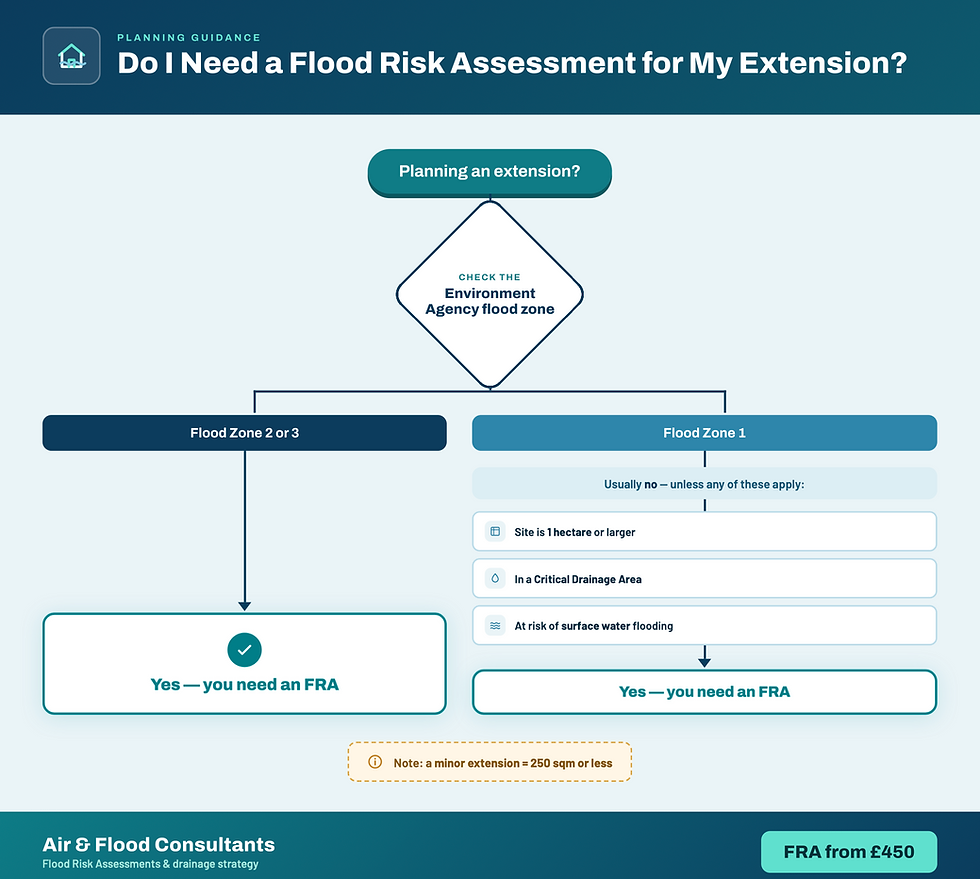
The starting point is the Environment Agency's "Flood map for planning". This splits England into flood zones based on the chance of flooding from rivers and the sea. Flood Zone 1 is low probability, Flood Zone 2 is medium, and Flood Zone 3 is high. Where your site falls largely determines whether a flood risk assessment is needed to support your extension.
Extension in Flood Zone 1
As a rule, you should provide an FRA for any development in Flood Zone 2 or Flood Zone 3 — and that includes minor development such as a house extension. So if the Environment Agency map shows your home in Zone 2 or Zone 3, expect to need one.
In Flood Zone 1, most small extensions won't need a full assessment. But there are important exceptions. You'll usually need an FRA in Flood Zone 1 if:
- the site is 1 hectare or larger
- the property sits in a Critical Drainage Area (an area your local council has flagged for surface-water drainage problems)
- the site is shown to be at risk from surface water, groundwater or other sources of flooding

Extension within high surface water flood risk
That last point catches a lot of people out. A home can be safely in Flood Zone 1 for river and sea flooding yet still flood from heavy rainfall that overwhelms local drains. The Environment Agency publishes a separate "Risk of flooding from surface water" map, and your council's local plan evidence may flag your road. If those sources are in play, an assessment is sensible even in a low-risk zone.
If you're unsure which zone you're in or what the colours on the map mean, it's worth reading our explainer on flood zones 1 vs 2 vs 3 before you go any further.

What counts as a "minor" extension?
In planning terms, a minor extension is one that adds no more than 250 square metres of floor space. Most domestic extensions — a rear kitchen-diner, a side return, a modest two-storey addition — fall comfortably within that. The distinction matters because the Environment Agency treats minor and major development differently, and minor householder works often qualify for a lighter-touch approach.
It's a common misunderstanding that small means exempt. It doesn't. A minor extension in Flood Zone 2 or 3 still needs to demonstrate it won't make flooding worse and that the people using it will be safe. Size affects the depth of the assessment, not whether one is needed at all.

Environment Agency standing advice and doing it yourself
For many minor and lower-risk extensions, the Environment Agency no longer comments on individual applications. Instead it publishes "standing advice" — a set of national guidance that the Local Planning Authority applies when deciding your application. This is good news for homeowners, because it means a smaller scheme can sometimes be supported by a straightforward assessment rather than detailed modelling.
In genuinely simple cases — say, a single-storey extension in the lower-risk part of Flood Zone 2, on a site with no basement and no surface-water concerns — a homeowner or architect who reads the standing advice carefully may be able to put together a basic flood risk statement themselves. The EA's flood risk assessment guidance sets out what to address.
That said, there's a point where a consultant earns their fee. If your site is in Flood Zone 3, near a watercourse, in a Critical Drainage Area, or involves a basement, the assessment quickly stops being a tick-box exercise. Getting finished floor levels, flood depths and resilience measures wrong can mean a refusal — or, worse, a property that floods. If in doubt, a properly prepared flood risk assessment removes the guesswork and gives the case officer exactly what they expect to see.
.webp)
What does an FRA for an extension actually cover?
A flood risk assessment for an extension is not a generic template. A good one is specific to your plot and your proposal. It will typically work through:

Flood sources and probability
The assessment identifies every realistic source of flooding for your site — rivers, the sea, surface water, groundwater, sewers and any nearby reservoirs or watercourses — and sets out the likelihood of each, both now and over the lifetime of the development with an allowance for climate change.

Finished floor levels
One of the most practical outputs is the finished floor level for the extension. Raising floor levels above a calculated flood level is one of the simplest ways to keep a room dry. The FRA recommends a level and explains how it relates to the design flood event.

Flood resistance and resilience
Where raising floors isn't possible or sufficient, the report sets out resistance measures (keeping water out — flood-resistant doors, airbrick covers, raised thresholds) and resilience measures (limiting damage if water does get in — solid floors, raised electrics, water-resistant materials). For a habitable room you'll usually need to show both have been considered.

Not increasing risk elsewhere
A core planning principle is that your development must not increase flood risk for your neighbours. The assessment shows that the extension doesn't reduce floodplain storage or worsen surface-water runoff. If you're paving over garden or adding roof area, this is where sustainable drainage — see our note on SuDS — often comes in.

Basements and below-ground extensions
If your project involves a basement or any below-ground extension, the bar is higher. Basements are particularly vulnerable: they fill quickly, they're hard to escape from, and they're exposed to groundwater as well as surface and river flooding. Many authorities expect basement habitable accommodation in flood risk areas to be supported by careful assessment, and in higher-risk zones a basement bedroom may simply not be acceptable.
Groundwater is the issue people forget. Even on a site in Flood Zone 1, digging down can intercept a high water table, leading to seepage and standing water. A groundwater flood risk assessment looks specifically at this, considering local geology, monitoring data and the depth of your dig, and recommends waterproofing and drainage to suit.
.jpg)
What happens if you don't provide one?
If your site needs a flood risk assessment and you don't submit one, two things can happen. The first is that your application isn't validated at all — the council returns it as incomplete before anyone even looks at the merits, costing you weeks. The second is that it gets refused, because a planning authority can't lawfully approve development in a flood risk area without understanding the risk. Either way, you lose time and the certainty you were after.
Submitting a sound FRA up front is almost always quicker and cheaper than fixing a stalled application later. It answers the case officer's questions before they're asked.
Get in Touch
If you'd like to know whether your extension needs a flood risk assessment — and a clear, fixed-fee quote if it does — send us your address and a sketch of what you're planning. We'll tell you honestly what's required and turn the report around quickly so your application stays on track.
Get in touch to discuss your site and receive a quote.
.webp)